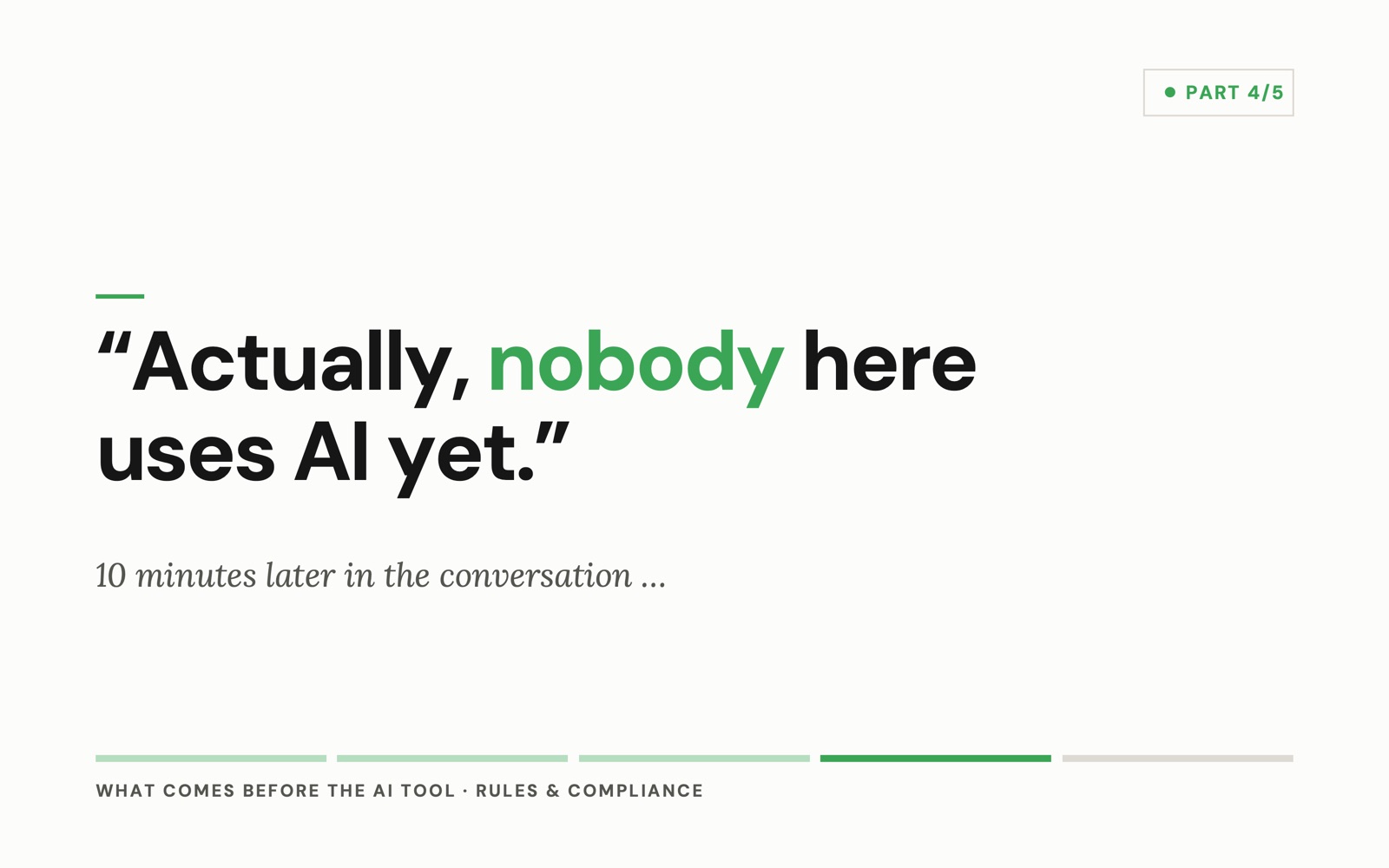
10 minutes later in the conversation: sales writes offers with ChatGPT. Marketing has texts rewritten. And the assistant summarizes minutes with a tool she discovered privately. 😅
AI models are already there, with or without rules
Without rules, valuable and sensitive information ends up in tools nobody knows where they store their data. That is exactly what is called shadow AI.
And there are obligations: under the EU AI Act, companies now have to be able to show that their employees use AI models competently. On top of that come the GDPR and, for software manufacturers, the Cyber Resilience Act (CRA). Information security & compliance therefore belong in from the start.
Good AI ground rules are not a list of bans
Good AI ground rules are not a 40-page document full of bans. They are clear orientation: what is allowed, what is not, and whom do I ask when I am unsure? Only then do employees dare to really use AI models. I described why well-calibrated rules give support instead of slowing people down in “Bringing the dial to the middle”.
3 questions for a self-check
- Do you know which AI tools are currently in use in your company?
- Do your employees know which data they are allowed to enter there?
- Could you prove today that your team has been trained in using AI models?
The series: What comes before the AI tool
- Part 1 · Kick-off: Why the tool is the easiest part
- Part 2 · Strategy & organization: Where should AI models take us as a company?
- Part 3 · Processes: Which processes should actually get better?
- Part 4 · Rules & compliance: What is the team allowed to do with AI tools, and what not? (this post)
- Part 5 · Information security: What happens to our data along the way?
A question for you
Which of these questions made you hesitate for a moment? 😉