
This week, I developed AI rules together with a small organization. The team has just started working with a shared AI tool. And the question came up very quickly: “What are we actually allowed to put into it?”
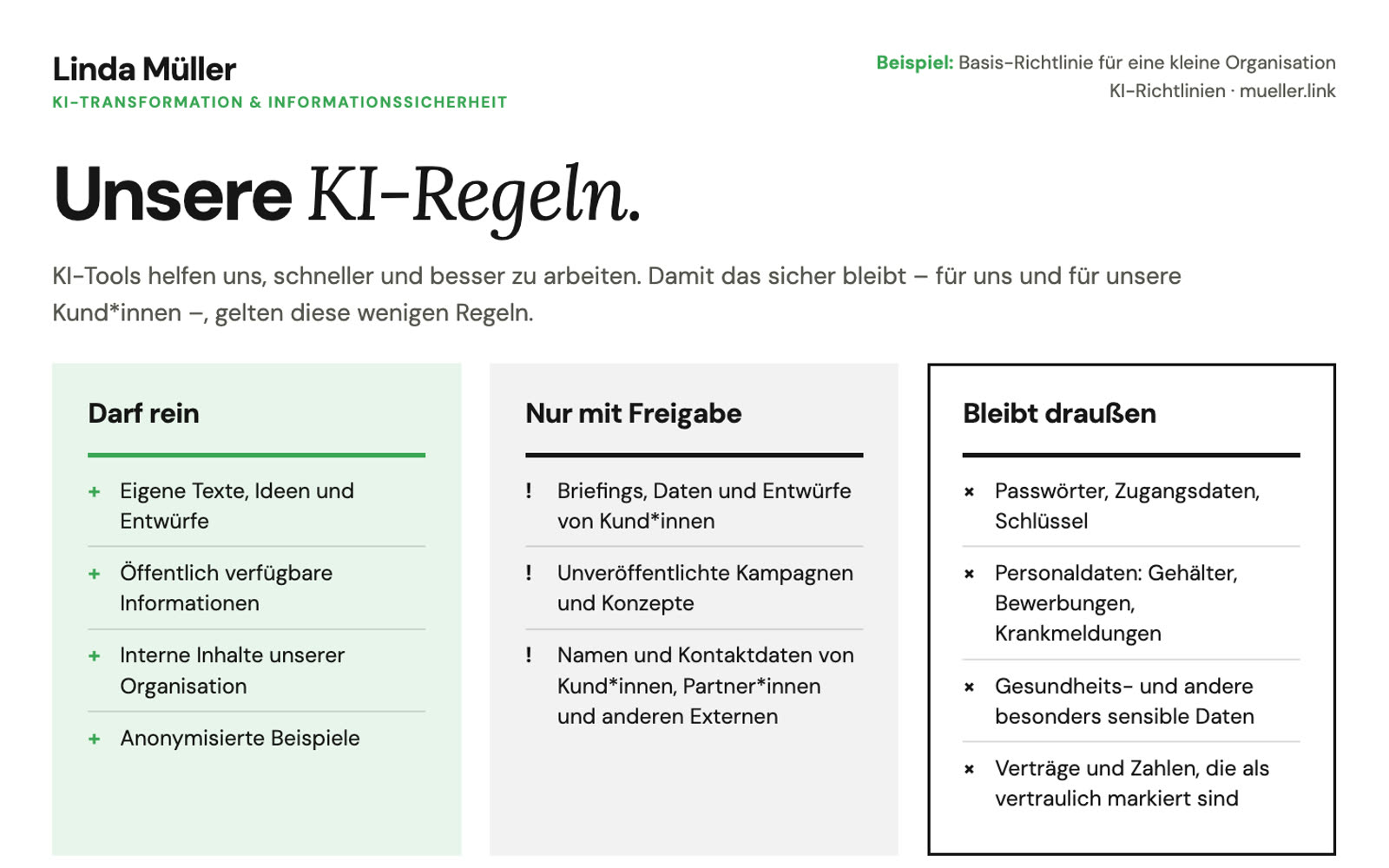
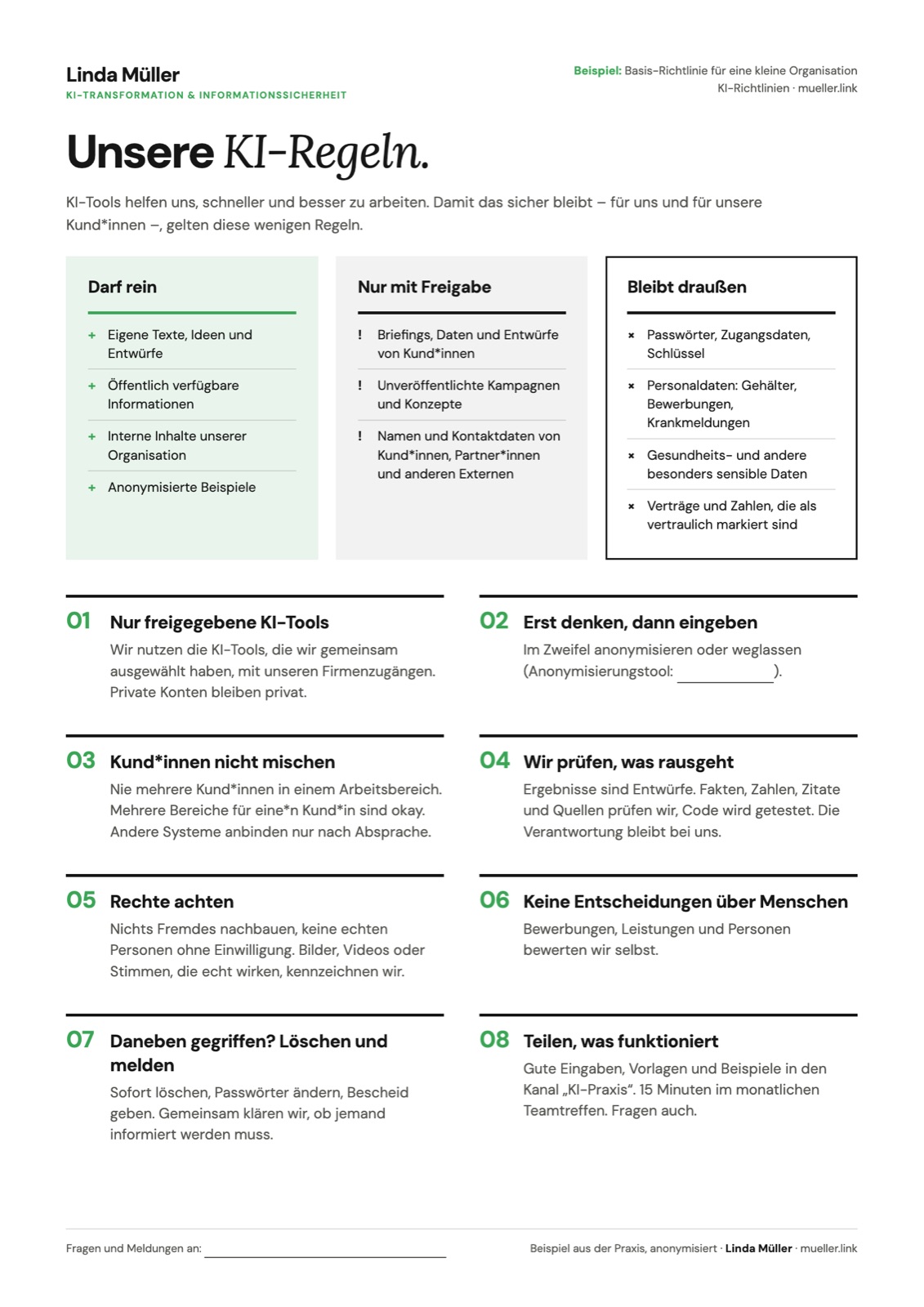
We wanted something people actually read. So we kept it short: a traffic light and 8 rules, all on one page.
The traffic light: what may go into the AI tool?
- May go in: your own texts, ideas and drafts, publicly available information, internal content of the organization and anonymized examples.
- Only with approval: briefings, data and drafts from clients, unpublished campaigns and concepts, and names and contact details of clients, partners and other external people.
- Stays out: passwords, credentials and keys, HR data such as salaries, applications and sick notes, health data and other especially sensitive data, and contracts and figures marked as confidential.
The 8 rules
- Only approved AI tools. We use the AI tools we selected together, with our company accounts. Private accounts stay private.
- Think first, then type. If in doubt, anonymize or leave it out. The poster has space to fill in your own anonymization tool.
- Don’t mix clients. Never several clients in one workspace. Several workspaces for one client are fine. Connecting other systems only after agreement.
- We check what goes out. Results are drafts. We check facts, figures, quotes and sources, and code gets tested. Responsibility stays with us.
- Respect rights. Don’t copy what belongs to others, no real people without consent. We label images, videos or voices that look real.
- No decisions about people. We assess applications, performance and people ourselves.
- Made a mistake? Delete and report. Delete immediately, change passwords, let someone know. Together we clarify whether anyone needs to be informed.
- Share what works. Good prompts, templates and examples go into the “AI practice” channel. Plus 15 minutes in the monthly team meeting. Questions too.
How do you find the essential AI rules?
For another organization, this would surely look different. Size, industry and data play a big role. That is why the poster is an example, not a template. The real value lies in the way there. This is how I approach it:
1. Clarify the starting point
Before we talk about rules, we look at everyday work: which AI tools are already in use, officially or on the side? Who uses them for what? And what data does the team work with, from their own texts to HR data? This quickly shows where the real risks are and where they are not.
2. In the workshop: go through the AI Rules Compass
Then we work with my AI Rules Compass: 36 topics in 6 areas that can come up in an AI policy, from foundations to processes, impact, data and responsibility to the overall framework. We go through it together, and for each topic there are three possible answers:
- We include it, because it comes up in everyday work or there is a real risk.
- We deliberately leave it out (for now), because other topics matter more. The topic is not forgotten: we discuss it and document it elsewhere, for example for the AI team or the people responsible. It comes back on the table at the next review. But it does not go into the rules for everyone, because those should be quick to understand and actually read and followed.
- We don’t need it, because it simply does not occur here.
The interesting part: most topics do not end up under “include”. And that is exactly the point.
3. Decide how binding and how specific
For every topic that remains, we clarify two questions. How binding should it be? A firm rule, a recommendation or just a note? And what exactly needs to be stated? Which AI tool is approved? Who is the contact person? Where do good examples go? A rule like “protect sensitive data” helps nobody. “HR data stays out” does.
4. Write it short, in the team’s language
Only now do we write. Short, specific and the way the team itself talks. For data, the traffic light has proven itself because it shows at a glance what is fine. Everything together should fit on one page.
5. Test with real cases
Then we test the rules with examples from everyday work: “May I put this briefing in?” “What do I do if I accidentally uploaded a client list?” If the rules do not give a clear answer, we sharpen them.
6. Roll out and keep it alive
Finally, we decide who answers questions, how new experiences flow back into the team and when the rules come back on the table. AI tools change quickly, and the rules should grow with them.
For this organization, the result was a traffic light and 8 rules. Elsewhere it might be 5, or 12. What matters is: less is more. A policy nobody reads protects nobody. I also wrote about why shared rules make such a difference in “Actually, nobody here uses AI yet.”
And now I am curious: what would you add or do differently? Is a rule missing, or is one too many?