Many companies are in a similar place right now. The licenses for Copilot, ChatGPT or Claude have been bought. 2 or 3 enthusiasts try everything and build themselves little helpers. Everyone else waits, feels unsure or simply has no time. And IT gets all the questions at once.
So the AI models are there. They just haven’t arrived in everyday work.
Knowledge spreads through people
A policy on the intranet changes little. Mandatory training creates a shared basic understanding, but no new habits yet. What really works is the colleague at the next desk who shows how she saves an hour of work every week. And whom you can simply ask.
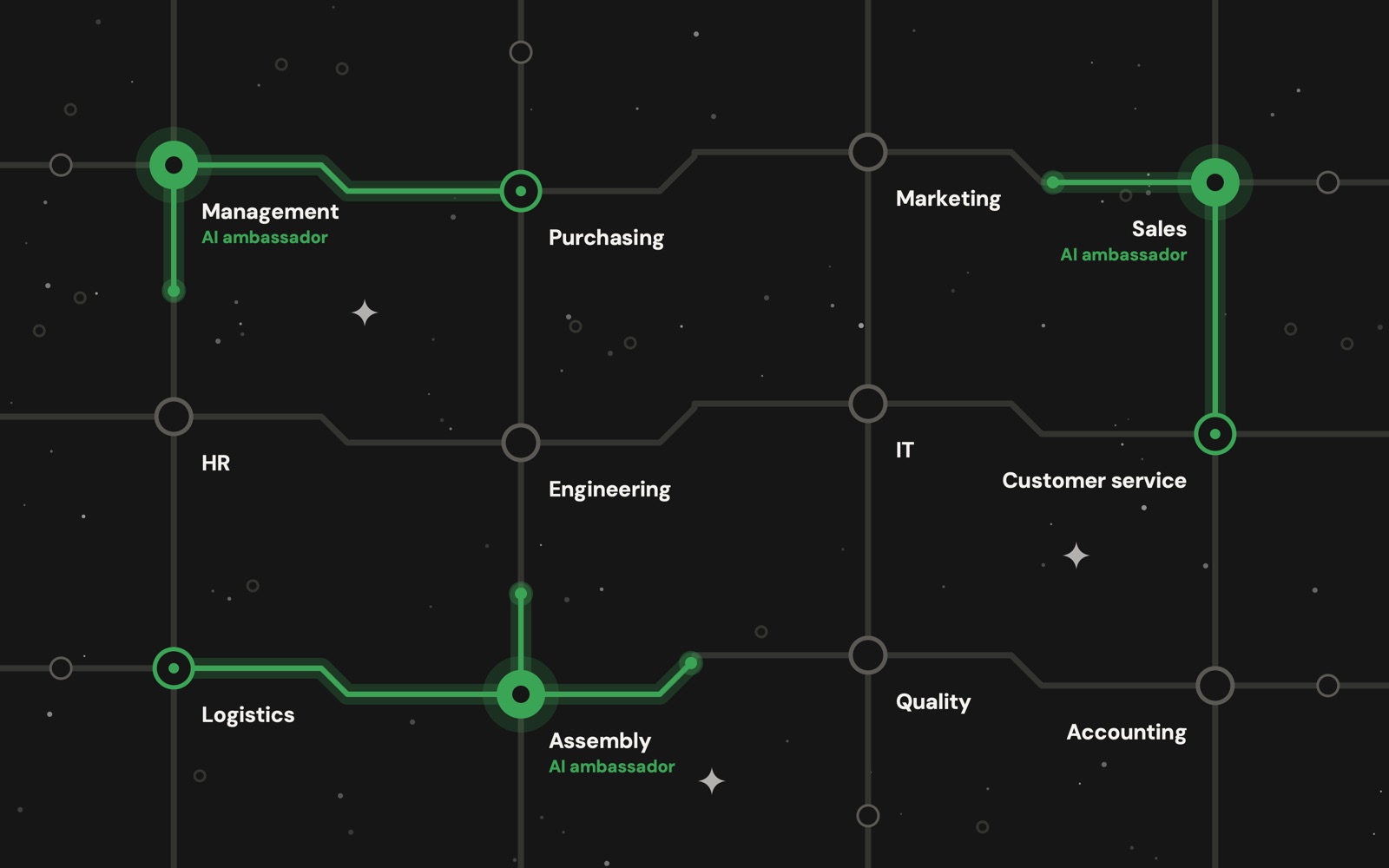
That is exactly the idea behind AI ambassadors: people in the departments who use AI models safely, improve processes and pass on their knowledge. Not as an extra job for IT, but right in the middle of everyday work.
Who becomes an ambassador
It has nothing to do with hierarchy. An ambassador can be the managing director, the head of purchasing or the employee from assembly. 2 things matter: curiosity and the will to change something. No prior knowledge is needed. You become an ambassador in the program.
What matters to me: ambassadors are won, not appointed. Someone who becomes “AI officer” against their will won’t carry the topic forward with enthusiasm.
How an AI ambassador program works
I tailor every program to the company: to its size, industry, prior knowledge and goals. The framework, however, is almost always the same, and it has proven itself.
1. Clarify the mandate
Before we start, I sit down with management. What should the program achieve? How much time do the ambassadors get for it? And what are they allowed to decide? Without a time budget, the program becomes a hobby alongside the actual job.
2. Win ambassadors
Instead of putting names on a list, I extend an open invitation: who’s interested? Ideally from as many departments and levels as possible. That creates a network that reaches across the whole organization.
3. Qualify, and more than prompting
A prompting course isn’t enough. Ambassadors need to understand how AI models work and where their limits are. They need to be able to make processes visible and simplify them. Because a bad process doesn’t get better with AI models, just faster. And they need clarity on information security & compliance: What do the GDPR, the EU AI Act and the Cyber Resilience Act allow? What do the company’s own certifications and internal rules require, for example ISO 27001, NIS-2 or TISAX? And which data has no business being in which tool?
I plan the qualification individually with you and deliver it right away, tailored to your tools, your processes and your rules. In addition, a fixed format for it is coming soon, bookable in-house or together with other companies. If you’re already interested, just get in touch.
4. Get into action
Every ambassador implements a first use case from their own area. Small, but real. Nothing convinces colleagues as much as a process that runs noticeably better afterwards.
5. Build a network
The ambassadors exchange regularly, share what works and offer office hours for their teams. Successes are made visible, for example in a short slot in the all-hands meeting.
6. Take stock
After a few months, we look back together: What has changed? Which use cases come next? And how does the program continue, with new ambassadors or new topics?
What it means in time
Management is needed mainly at the beginning and the end: 2 to 4 hours each for the kick-off and the close. The ambassadors should plan an average of 2.5 to 3.5 hours per week across the whole program. That covers the joint sessions, work on their own use case and the exchange with each other.
Why ambassador programs fail
I keep coming across these stumbling blocks:
- Appointing instead of winning: mandatory ambassadors don’t pass on any fire.
- Training only tools: knowing where to click doesn’t improve processes.
- No time budget: without dedicated time, the program loses momentum after a few weeks.
- Security as an afterthought: if information security & compliance are only clarified at the end, you build shadow AI right along with it.
- Successes stay invisible: if nobody sees what the ambassadors achieve, someone will soon ask what it’s good for.
And if management isn’t convinced yet?
A few weeks ago someone told me: “Actually, I first want to convince my manager that this is the right way.” That’s a good start. My tip: start small, with 1 or 2 people and a real use case. A process that runs better afterwards is the best argument for more.
A question for you
When you think about your company: who would be your first AI ambassador? And does that person already know?